
Built to the law, and honest about what that means.
No software makes an agency compliant. Templace makes the compliant path the easy one, refuses the steps that would break the law, and keeps the evidence of everything it stopped.
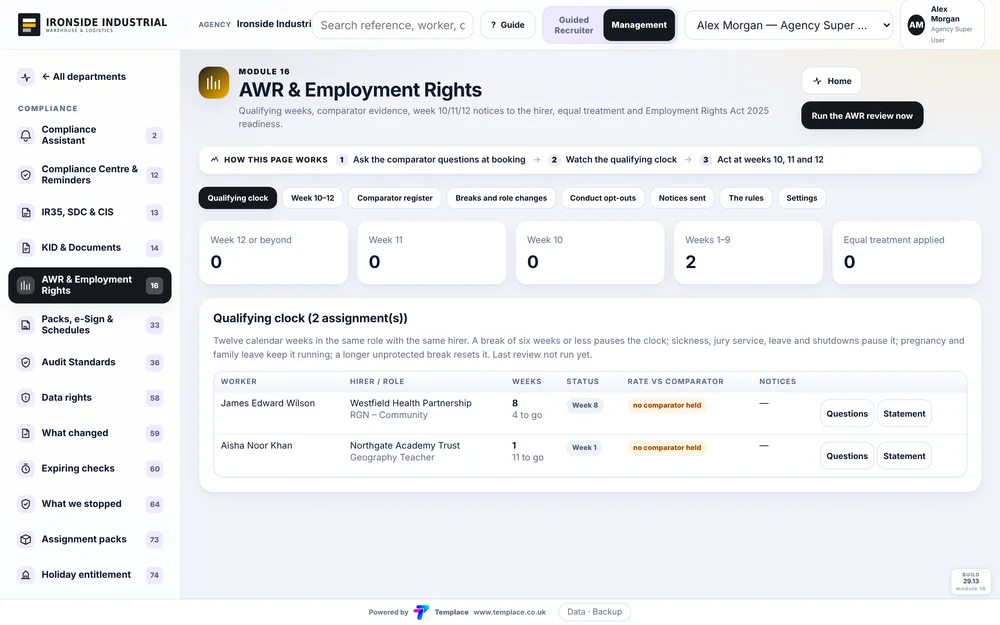
The twelve weeks, counted from what actually happened.
Qualifying weeks come from the timesheets, not a start date typed months ago. Breaks that pause the clock and breaks that reset it are applied, a change of role is caught, and hirers are told in time.
- Weeks 10 to 12 warnings to the hirer
- Breaks and role changes applied to the count
- Conduct Regulations opt-outs recorded
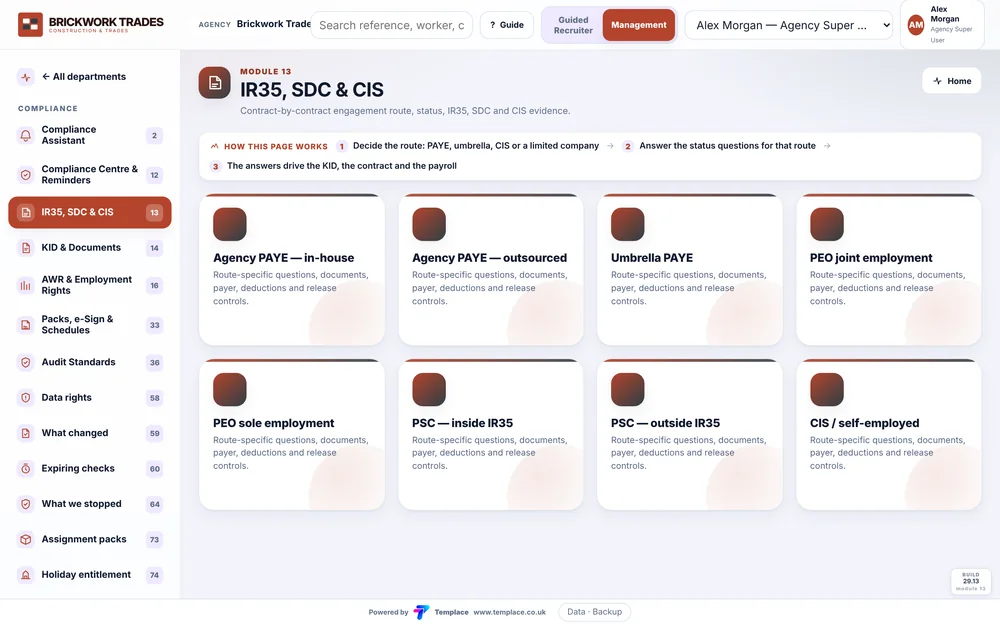
Status decided before anyone is paid gross.
Supervision, direction or control is assessed with a question set before a worker goes on CIS or through a limited company. An unanswered sheet is never a pass, and three answers fail it whatever the score.
- CIS verification recorded before the first payment
- Inside IR35 deemed payments through the payroll
- Framework hirers refuse CIS and limited company routes
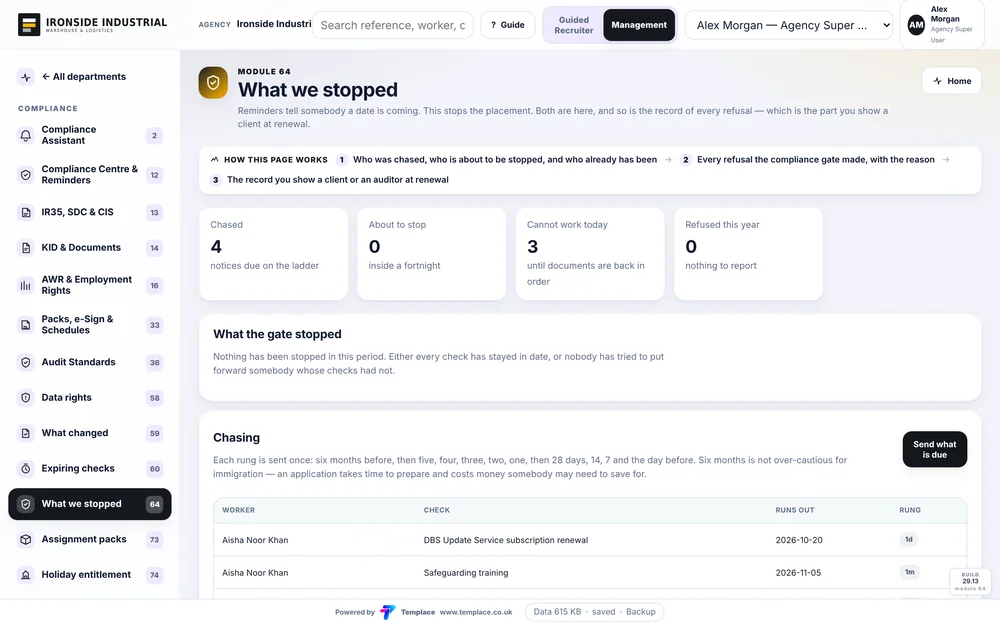
The evidence that the controls work.
A register of every booking, payment and document the platform refused, and every waiver granted, with the rule, the person and the time. It is the first thing to show an auditor.
- Refusals and waivers side by side
- The rule, the person and the time on every line
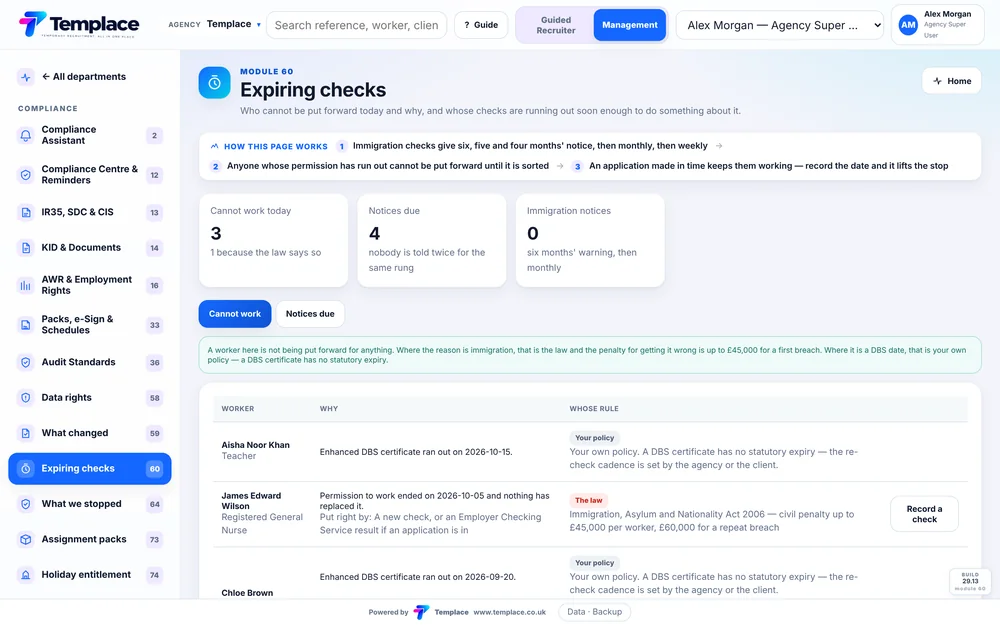
Nothing lapses without a warning first.
Every dated check, registration and training record is watched. Notices go out before expiry, and on the day a check lapses the worker drops out of the bookable pool on their own.
A privacy notice written from what is actually held.
Each collection carries its retention rule and the authority for it. The notice a worker sees is generated from that, and one screen shows everything held about one person when they ask.

What each Act asks, and what Templace does about it.
A summary to show where the platform fits, not legal advice. The legislation itself is the authority, and your own advisers are the people to ask about your business.
Employment Agencies Act 1973
Governs employment agencies and employment businesses, and is the Act the Conduct Regulations are made under. Enforcement passed to the Fair Work Agency in April 2026.
In Templace: Templace is built around the employment business model: you engage the worker, pay them and charge the hirer, and each record shows which side of that it sits on.
Conduct of Employment Agencies and Employment Businesses Regulations 2003
Terms with hirers before services are provided, a key information document for work-seekers, limits on transfer fees, and records kept for at least a year after the last service.
In Templace: A deal cannot reach agreed in the pipeline without regulation 17 terms on file; a KID is built for every pay route; retention runs from the last date of service.
Employment Rights Act 1996
A written statement from day one, an itemised payslip showing hours where pay varies with time worked, and no deduction from wages without authority.
In Templace: Payslips are itemised to section 8, and a deduction cannot be added without its authority and purpose recorded.
Agency Workers Regulations 2010
Access to facilities and vacancies from day one, and equal basic pay and conditions after twelve weeks in the same role with the same hirer.
In Templace: Qualifying weeks are counted from the timesheets, with breaks and role changes applied, and hirers warned in weeks 10 to 12.
Working Time Regulations 1998
Holiday entitlement and pay, daily and weekly rest, and the average 48-hour week unless the worker has opted out. Since 6 April 2026, records of leave and holiday pay must be kept for six years.
In Templace: Entitlement accrues in hours, holiday pay uses the reference period, leave records are kept for six years, and the booking gate refuses a shift that breaks daily rest or the weekly limit.
Employment Rights Act 2025 and the Fair Work Agency
The Fair Work Agency brings together the enforcement work of the Employment Agency Standards Inspectorate and the Gangmasters and Labour Abuse Authority, with minimum wage enforcement to follow from HMRC.
In Templace: When an inspector asks, the answer is a register you can print, not a project to assemble.
Finance Act 2026: umbrella companies
Where an umbrella company does not operate PAYE, the agency that contracted with it — or the end client where there is no agency — is jointly and severally liable for the tax.
In Templace: Intermediaries are held on an accredited list, and each worker’s umbrella pay is reconciled from assignment rate to gross so a shortfall is visible.
National Minimum Wage Regulations 2015
Pay for the hours worked must reach the minimum wage for the worker’s age, after any deduction that benefits the employer.
In Templace: Timesheets are checked against the floor before approval, and payroll holds deductions that would take pay below it.
UK GDPR and the Data Protection Act 2018
Personal data kept no longer than needed, for a stated purpose, with a right to see what is held.
In Templace: Every collection carries a retention rule and its authority, and a single screen shows what is held about one worker.
Immigration, Asylum and Nationality Act 2006
Civil penalties of up to £45,000 per worker, £60,000 for a repeat, unless the prescribed check was made before work began. Since 1 October 2026 (Border Security, Asylum and Immigration Act 2025, s.48) the duty covers workers, individual sub-contractors and online platforms too, and reaches up supply chains.
In Templace: Everyone is checked the same way before release: a W share code checked on the Home Office service with the profile kept, a Right to Work DVSP on the OfDIA register, or originals seen in person. Supply-chain suppliers confirm the right to work terms and declare each worker's check.
See it with your own agency’s name on it.
A trial runs on sample data in your colours and your logo, so the people who will use it can judge it as theirs. Tell us your sector and how many workers you place in a week.